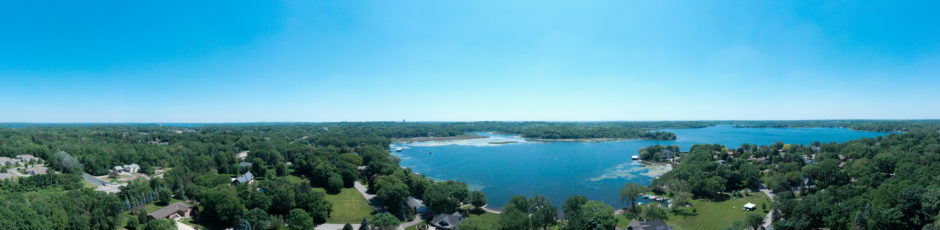
Officials have pulled “literal tons” of the goldfish out of lakes and storm drains across the Twin Cities, but the population grows as people dump them.
The Minnesota Star Tribune
JUNE 5, 2026 AT 10:27AM
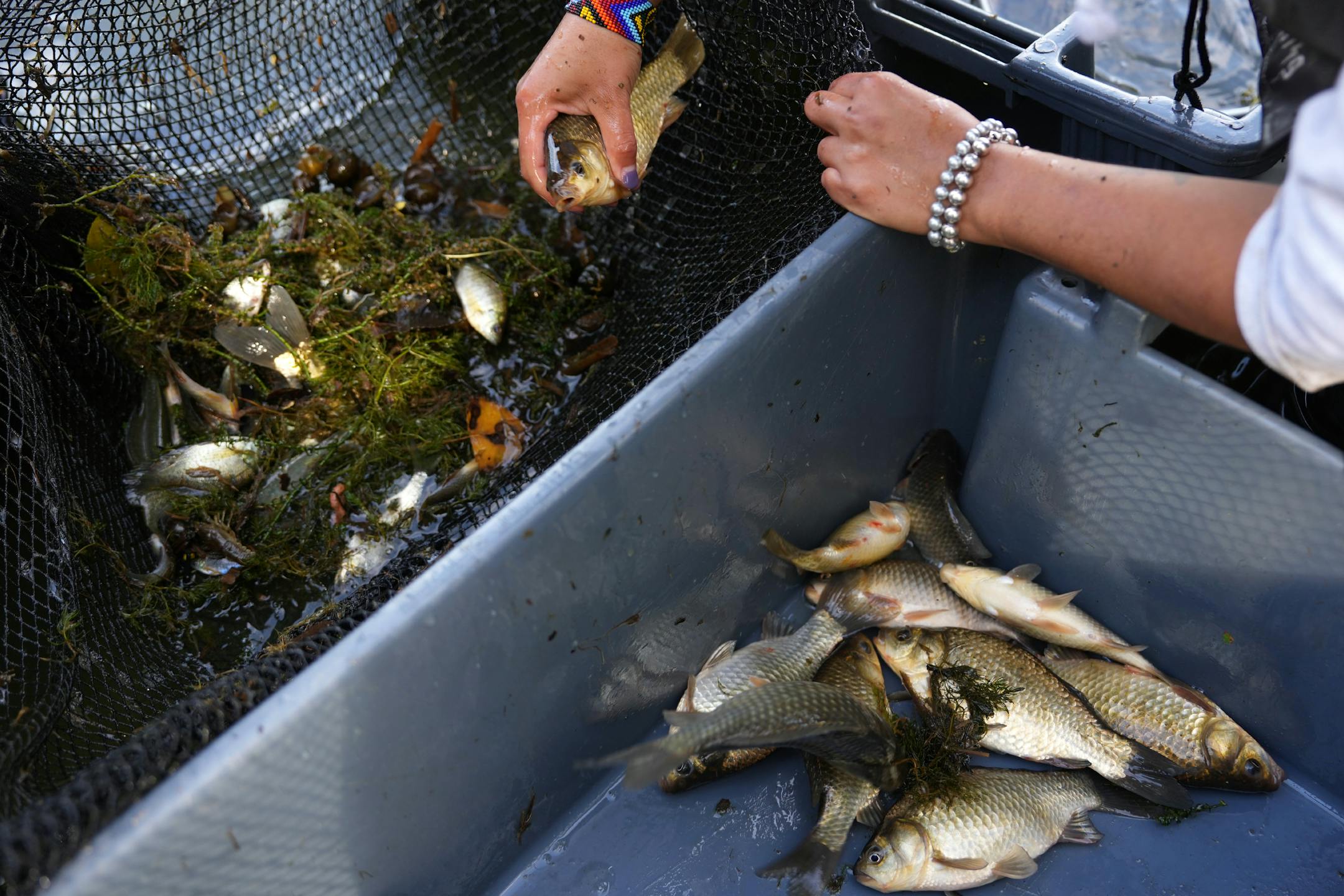
Goldfish, like these caught and removed from Edina’s Lake Cornelia in September 2025, continue to be a problem in Twin Cities lakes and storm drains. (Anthony Soufflé/The Minnesota Star Tribune)
Dozens of organizations help rehome dogs and cats when people can no longer care for them.
But rehoming another kind of pet — goldfish — is being floated as a way to clear waters flush with them.
The idea comes amid a rise in the population of the often oversized, orange-hued fish in ponds, lakes and storm drains across the Twin Cities. The problem has been growing for yearsthanks in part to people dumping their family fish tanks in the waterways.
Removing the fish, an invasive species, costs cities hundreds of thousands of dollars. Local officials have pleaded with people not to dump them, and in some cases, used the fish to feed bears at the Minnesota Zoo.
Community leaders and experts believe pairing the rehoming efforts with strategies for removal, including netting and fishing, might be the solution to getting rid of the former pets for good.
“[Large goldfish populations] are kind of becoming a new thing we’re noticing around Minnesota,” said Andrew Dickhart, the aquatic invasive species program coordinator for Carver County. “It takes just a few pet releases to really do a lot of damage on a local water or lake system that is enjoyed by a lot of people.”
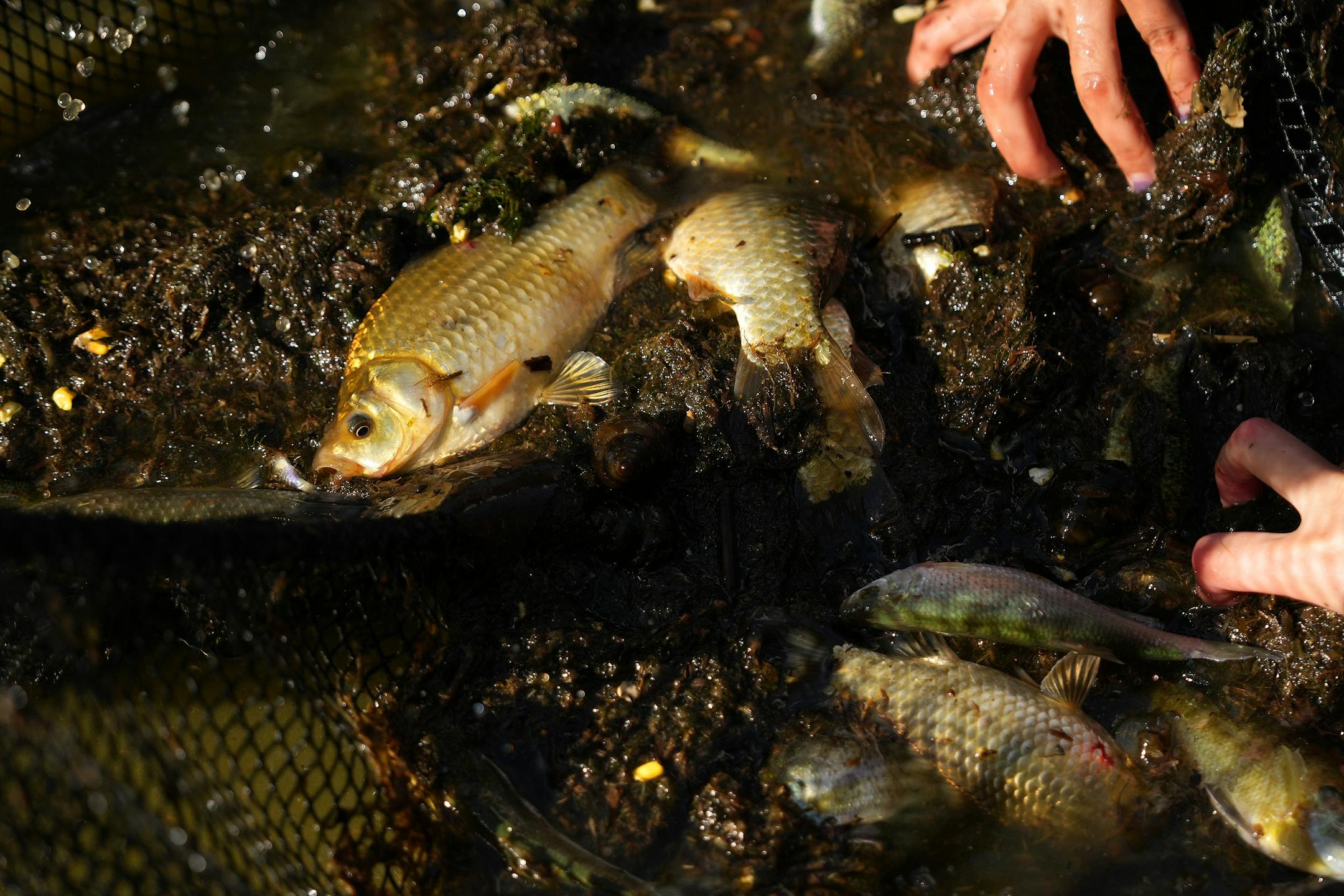
Some city officials are urging residents to find new homes for fish instead of dumping them in the wild. (Anthony Soufflé/The Minnesota Star Tribune)
Rehoming efforts grow
Goldfish, carp cousins that unsettle lake bottoms, have been a problem in Minnesota for several years.
“They uproot native aquatic plants, and when the water is cloudy, sunlight can’t reach the bottom, and it leads to vegetation die-offs that native fish need,” said Hilarie Sorensen, a water resources extension educator at the University of Minnesota Duluth. “They are able to out compete native species for food and space.”
Dickhart has been fighting the fish since 2019, when Carver County saw a drastic increase in their numbers, mostly in the Grace Chain of Lakes in Chaska.
“All of the sudden, kaboom,” he said, “we had this huge population of aggregating goldfish.”
The county has spent thousands of dollars to catch the fish, even getting a permit from the state for electro-fishing, which stuns the animals so they can be removed.
Dickhart said his team has already seen marked water quality improvements since they removed “literal tons” of fish.
But people are still dumping them. So now, more communities are advocating for people to rehome their pets.
Sandy Moore, CEO of the national Pet Advocacy Network, said that can be as simple as bringing a goldfish back to the point of purchase. Habitattitude, a campaign by the Pet Advocacy Network to properly dispose of unwanted pets, hosts fish surrender events in Minnesota, she said.
There are also Facebook pages for fish swaps, she said, or people can contact the Minnesota Aquarium Society to find a new family for aquatic animals.
“The effects of releasing your pet into the wild is that fish is going to be somebody’s dinner,” she said. “Or, worst-case scenario, that animal becomes established, could reproduce and could displace native animals.”
Dickhart said rehoming is an essential part of minimizing the number of goldfish in Minnesota storm drains, ponds and lakes. Carver County has partnered many times with organizations to transfer pets, he said, rather than release them in the wild.
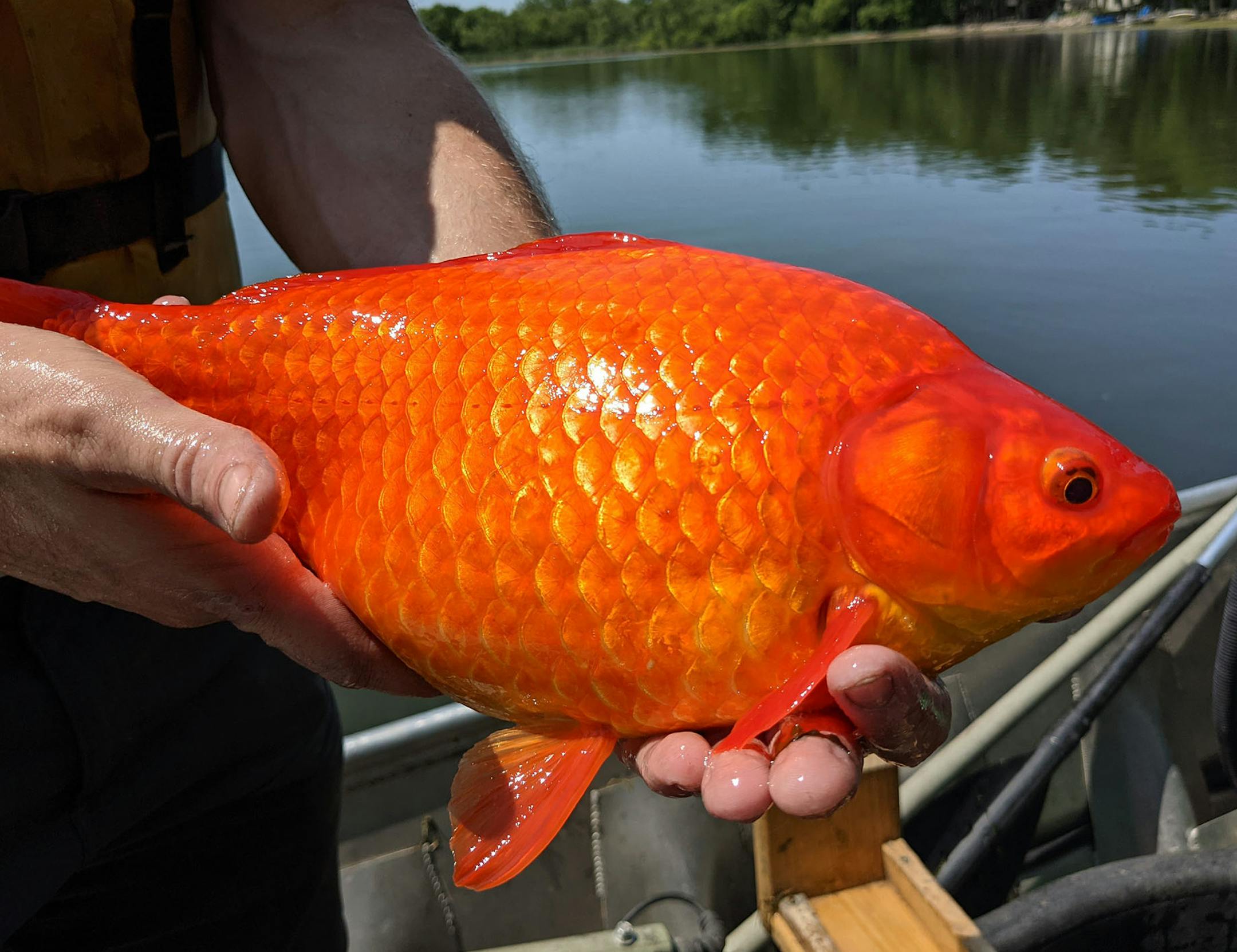
A football-sized goldfish was fished out of Burnsville’s Keller Lake in 2021. (City of Burnsville/The Minnesota Star Tribune)
The difficulties of catching goldfish
While they are relatively easy pets to care for, goldfish are actually a quite complicated species.
“They’re hearty little creatures and they undergo quite a transformation,” Sorenson said. “In the wild, they have no natural predators. They can grow to the size of a football or a dinner plate. They can weigh several pounds.”
Goldfish also don’t follow a pattern in terms of swimming or mating, but the Carver County staff in pursuit of them say the fish seem to catch on.
“Goldfish seem to just do what they want when they want,” Dickhart said. “They’re not dumb fish; they do have pattern recognition.”
When the Woodbury City Council discussed the fishy issue — a “mass of gold” in a pond near Powers Lake — at a May meeting, Mayor Anne Burt suggested people skip buying goldfish on impulse if they can’t care for them long term.
Instead, she said: “Purchase goldfish crackers, if you’re a goldfish lover.”
ABOUT THE WRITER
Eleanor Hildebrandt
REPORTER
Eleanor Hildebrandt joined the Minnesota Star Tribune as a fellow in June 2025. She was part of the team that won the Pulitzer Prize for Breaking News in 2026. Hildebrandt can be reached on

