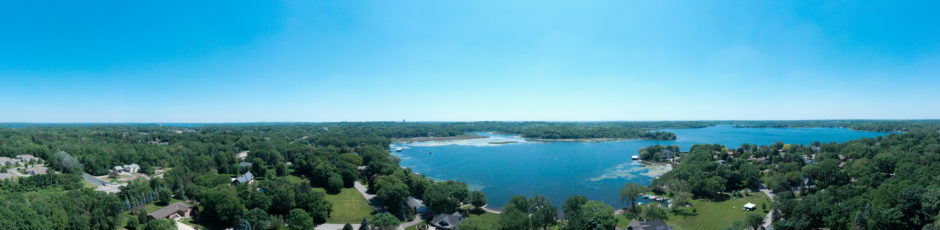
At the October 11th LMPA Annual Meeting, Andrew Dickhart, Aquatic Invasive Species Coordinator from the Carver County Planning & Water Management department, reviewed the Lake Minnewashta Aquatic Invasive Species (AIS) monitoring program and its findings. Drew is a valuable resource for the LMPA and helps guide and support our efforts to prevent new invasive plants from entering the lake and reduce the level of invasives we currently have.
The Lake Minnewashta Preservation Association (LMPA) welcomed members and neighbors to its 2026 annual meeting. President Steve Gunther recognized the dedication of the association’s board: Vice President Scot Lacek, who works on invasive weed treatment permitting, DNR funding, rock hazard mapping and the artificial-intelligence voice reminder at the Carver boat launch; Kevin Zahler, a Minnesota Water Steward and leader on aquatic invasive species and shoreline buffers; Treasurer Anne Ripple; Secretary and annual meeting planner Helen Gunther; and board members Matt Keuseman, Doug Tanner, Dan Wendel of Camp Fire Minnesota and Nancy Simpson of the Pleasant Acres association.
The association also expressed appreciation to the July 4th event organizers and T-shirt committee, Gary Bhwojani and the team who kept the 2026 fireworks show going, and its volunteer neighborhood captains, led by Rose Mastricola. These volunteers, together with lake monitors, event participants and board members, are essential to LMPA’s work.
A year of accomplishments
Overall, 2026 brought several positive developments for Lake Minnewashta. High lake levels did not trigger slow- or no-wake restrictions. Using donations and reserves, LMPA treated acres of curly-leaf pondweed, while invasive Eurasian milfoil was nearly undetectable and did not require treatment. Carver County continued to support inspections of 100 percent of incoming watercraft at the Regional Park launch, and the association is not aware of any new invasive species introduced into the lake.
LMPA ended the period with approximately $65,000 available to respond to a newly discovered invasive species, with most of its assets held in high-yield certificates of deposit. It also continued partnerships offering expertise and grants to watershed property owners interested in shoreline buffers and rain gardens, which reduce runoff and help improve water clarity. Working with the Carver County Sheriff’s Office, the association placed markers at additional rock hazards around the lake.
The association updated its bylaws to expand its mission and purpose, clarify membership and voting rights, and formalize leadership and decision-making procedures. The changes establish a $100 annual-dues Voting Member category, a board of five to nine directors serving staggered two-year terms, and stronger provisions for financial oversight, accountability and legal protections. The board also approved a new business sponsorship program to diversify revenue.
Challenges facing the lake
Despite these accomplishments, lake water quality remains a concern. Compared with past years, water clarity and algae conditions have deteriorated. Curly-leaf pondweed was prolific, and native aquatic vegetation has increased as clarity improves. The Minnesota Department of Natural Resources denied LMPA’s proposal for a broader, ongoing lakewide treatment program, so the association treated only the maximum acreage the DNR authorized.
Fundraising also fell short. Donations totaled approximately $3,500, compared with a $15,000 goal and $7,600 the previous year. Only 13 households contributed, including four board members. At the same time, Carver County is considering cutting its financial support for incoming watercraft inspections. To help preserve that prevention program, LMPA has pledged $10,000 for 2027.
Zebra mussels are another growing concern. In 2019, only a handful were observed in the main part of the lake; they are now widespread. No property owner took advantage of LMPA’s shoreline buffer and rain garden program this year. The association also continued to receive complaints about a small number of boaters generating large wakes near shore or other users, playing loud music, operating without lights, and riding on transoms or towers.
Priorities for 2027
In 2027, LMPA will focus on improving lake water quality, preventing invasive species and strengthening participation and funding. It will continue to educate residents about reducing runoff through shoreline buffers and rain gardens, promote existing grants and design assistance, and expand the Adopt a Drain program.
The association plans to communicate its funding needs more effectively and increase revenue through its new annual-dues program and $250 business sponsorships. Invasive species prevention will remain a priority, including inspections of all incoming watercraft, Clean–Drain–Dry education and exploration of measures related to noninvasive aquatic vegetation. LMPA will revisit with the DNR its proposal for broader curly-leaf pondweed treatment aimed at complete eradication, recognizing that the program would require additional member donations.
LMPA will track research and developments in zebra mussel eradication and support the University of Minnesota’s Minnesota Aquatic Invasive Species Research Center (MAISRC). It will also work with MnDOT on water protection issues related to the Highway 5 expansion, collaborate with local and state organizations to strengthen lake associations’ collective voice, and continue efforts to promote safe, respectful boating. Matt Keuseman is updating the association’s boating etiquette guidelines, and LMPA is awaiting the results of the University of Minnesota’s wake studies. Recruiting additional neighborhood captains and board members is another priority.
How lake residents can help
The health of Lake Minnewashta depends on participation by its residents. LMPA encourages tax-deductible contributions through Zelle, Venmo, check or PayPal, as well as employer matching gifts. A $100 annual contribution qualifies a household for voting membership; the association recommends $250 contributions from shoreline owners and homeowners associations.
Residents can also improve water quality by installing shoreline buffers or rain gardens using available design resources and grants, keeping leaves and debris out of streets and storm drains, and hiring permitted lake service providers for shoreline work. To prevent the spread of aquatic invasive species, boaters should avoid transferring mussels on boats, toys or lifts, clean, drain and dry watercraft before and after launching, and inspect docks, lifts and boats for zebra mussels when equipment is removed in the fall. Everyone on the lake is encouraged to know and follow boating rules and to share the water responsibly.
Members can stay connected by registering their email address at info@lakeminnewashta.org and volunteering as a neighborhood captain, board member or committee participant.
Closing thanks
LMPA thanks guest speakers Andrew Dickhart and Kory Redepenning, host Camp Fire Minnesota, meeting planner Helen Gunther, donors, neighborhood captains, lakewide volunteers and its board of directors. Their combined efforts help preserve and protect Lake Minnewashta for everyone who enjoys it.
Steve Gunther
President, Lake Minnewashta Preservation Association
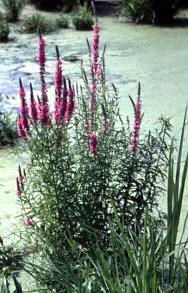
Purple Loosestrife is spreading rapidly around Lake Minnewashta, and we need residents’ help to control it before it becomes even more widespread.
Just a few years ago, only a handful of plants were visible around the lake. Today, Purple Loosestrife can be found in numerous locations, including extensive growth along the paved walking trail at Lake Minnewashta Regional Park, directly out from the fishing pier, as well as on several residential properties around the lake.
If you have Purple Loosestrife on your shoreline or property, please take action now. Review the attached identification and removal instructions, inspect your property, and properly remove any plants you find.
Every plant removed before it produces and spreads more seed can make a difference. Working together, lake residents can help slow the spread of this invasive species and protect the native plants and shoreline habitat of Lake Minnewashta.
Please check your property and remove Purple Loosestrife now.
Refer to the document below and the DNR website HERE for more information
Shorelines are divided into four zones. Each has an important role in a healthy lakeecosystem and hosts specific plants based on their ideal growing conditions. The four areas are aquatic, emergent, transitional, and upland. Together, these zones make up the larger buffer zone that serve as a lake’s best support and defense line.
Aquatic plant zone The aquatic zone starts in the water. This zone is always submerged in the water and is home to floating vegetation.
Importance – Aquatic plants create habitats for fish, amphibians, and other wildlife that depend on plants for homes. – They provide oxygen required for all aquatic life. – They hold the lake bottom in place and absorb nutrients like phosphorus. If plants are removed, often algae is the next thing that uses that phosphorus.
Keep it healthy To keep this zone healthy, leave as many aquatic plants as possible. Lakeshore owners may clear a path 15 feet wide for moving watercraft in and out. Anything wider requires a permit from the MN DNR.
Emergent plant zone
Next is the emergent zone, where the water is shallow and plants start to emerge. The plants grow roots underwater but stems and leaves grow above.
Importance – These plants stabilize the lake bottom. They keep the soil together and help protect the bank by breaking wave action. – This zone is fish spawning habitat for many fish species including native sunfish. Plants protect these nesting areas and ensure healthy fish populations.
Keep it healthy It is crucial to limit the removal of emerging plants to keep your shoreline healthy.
Transitional plant zone Above the emergent zone is the transitional zone. The soil in this zone ranges from moist to saturated and is home to wildflowers, shrubs, grasses, and sedges.
Importance – These plants prevent shoreline erosion and absorb excess nutrients such as phosphorus or nitrogen. Their deep roots hold the ground together to strengthen the soil, protect from erosion, and filter rain runoff removing pollutants before it reaches the lake.
Keep it healthy Avoid mowing near the shoreline. Create a designated access path to your shore up to 12 feet wide to let native plants on either side flourish.
Upland plant zone Finally, the uppermost and driest zone is called the upland zone. This portion of the buffer zone ranges from moist to dry soil and grows plants that withstand drier conditions along with vegetation similar to the transitional zone.
Importance – Upland plants capture and filter rainwater runoff and the pollutants it can carry. This is the lake’s first line of defense with runoff pollution. – This zone provides stability to the land and strengthens the soil beneath it with its deep roots.
Keep it healthy Capture rainwater on site and allow it to soak into the ground. Do this by using more native plants in your landscaping, mowing the grass higher (at least 3”).
Build a raingarden or rainwater reuse system to capture rain runoff and reduce nutrients washing into the lake.
Ordinary High Water Level
Something to note on your shoreline is the ordinary high water level. This is the boundary of the water that determines the highest water level maintained to suggest where the vegetation changes from aquatic to terrestrial. It will vary depending on the shoreline. Any work done below this level may have additional permits or rules.
Restore and maintain native plants in all zones to protect the lake A healthy shoreline is a healthy lake. Practicing sustainable shoreland management by restoring or maintaining native plant populations in each zone is key to having a healthy lake.
Provided by the folks at the Carver County Water and Environmental departments
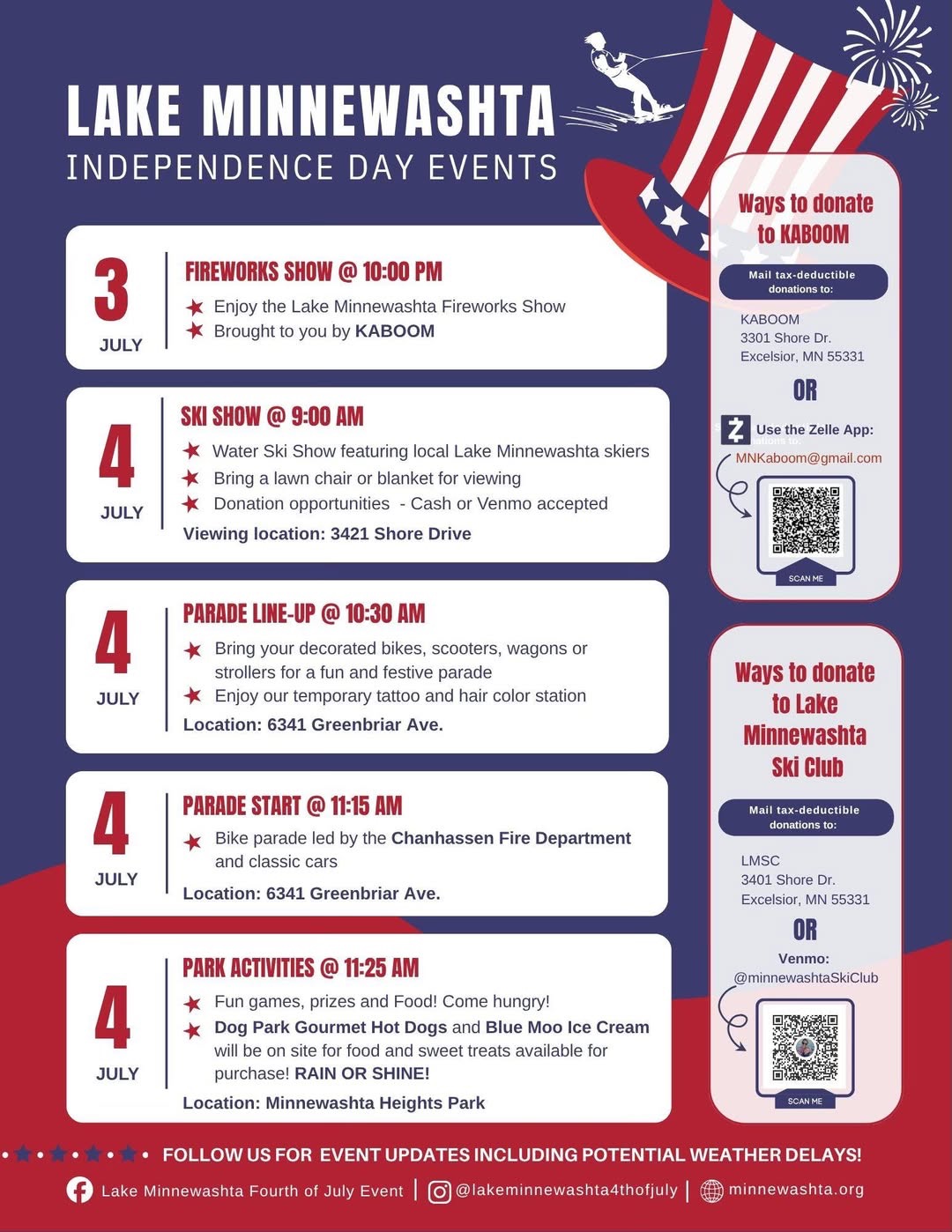
We’re just days away from celebrating America’s 250th birthday, and the Lake Minnewashta community is ready to celebrate in a big way!A fantastic group of volunteers has put together an exciting lineup of events for July 3rd and 4th, and we hope you’ll come out and join the fun. Check out the schedule below and make plans to celebrate with your neighbors and friends.
One of the highlights of the weekend will be the spectacular KABOOM fireworks display over Lake Minnewashta on July 3 at 10:00 PM. It’s a tradition we all look forward to, but this year the fireworks fund is still short of its goal. If you’re able, please consider making a donation to help keep this wonderful community tradition alive for years to come.
Our amazing Lake Minnewashta Water Ski Club is planning a great show on July 4th at 9AM. They are accepting donations to help cover the costs of fuel, equipment, and maintaining their outstanding performances throughout the season.
If you’d like to support either of these great community traditions, simply use the Zelle QR codes or mail a check. Every contribution, large or small, is greatly appreciated.
Thank you for helping make Lake Minnewashta such a special place to celebrate!
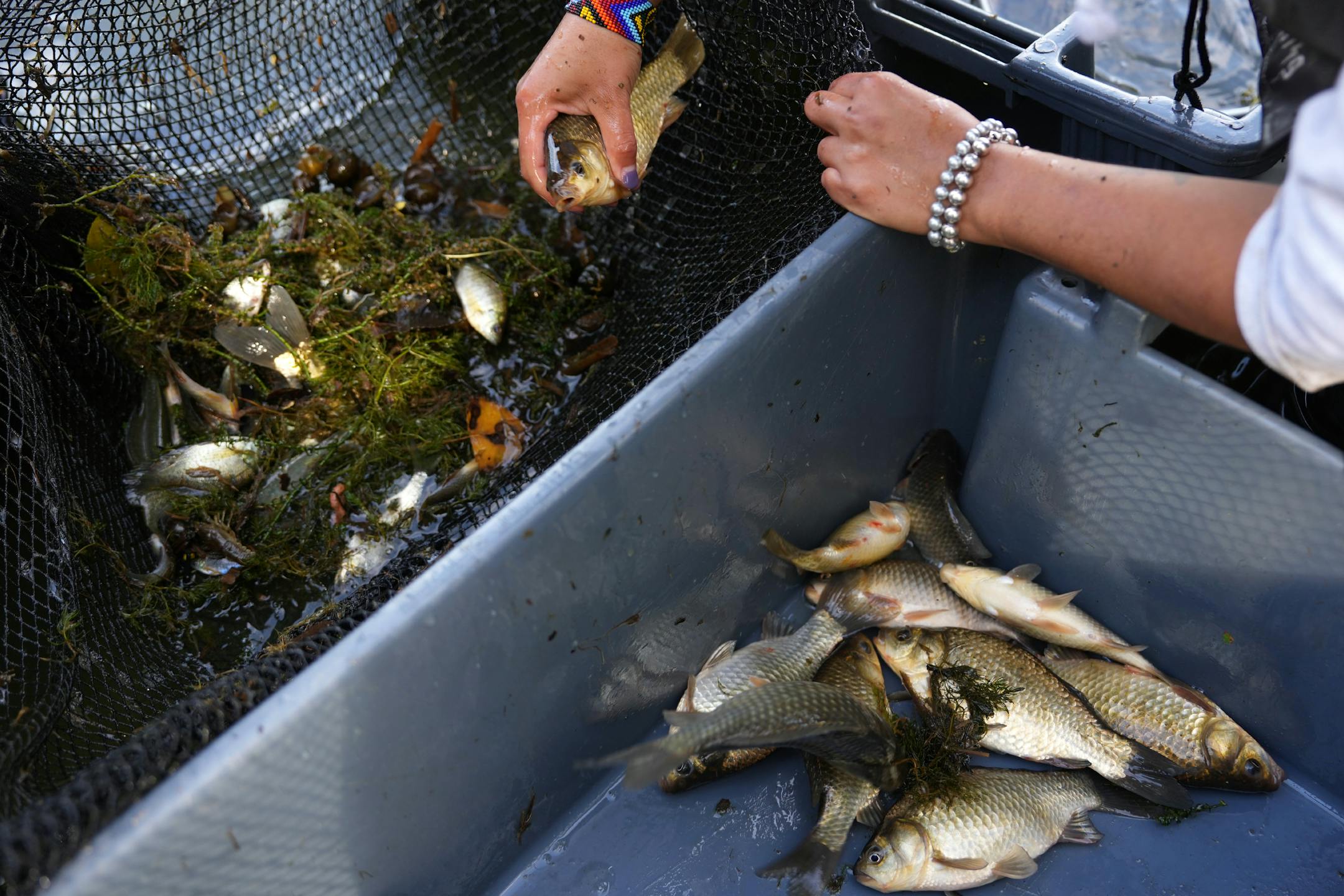
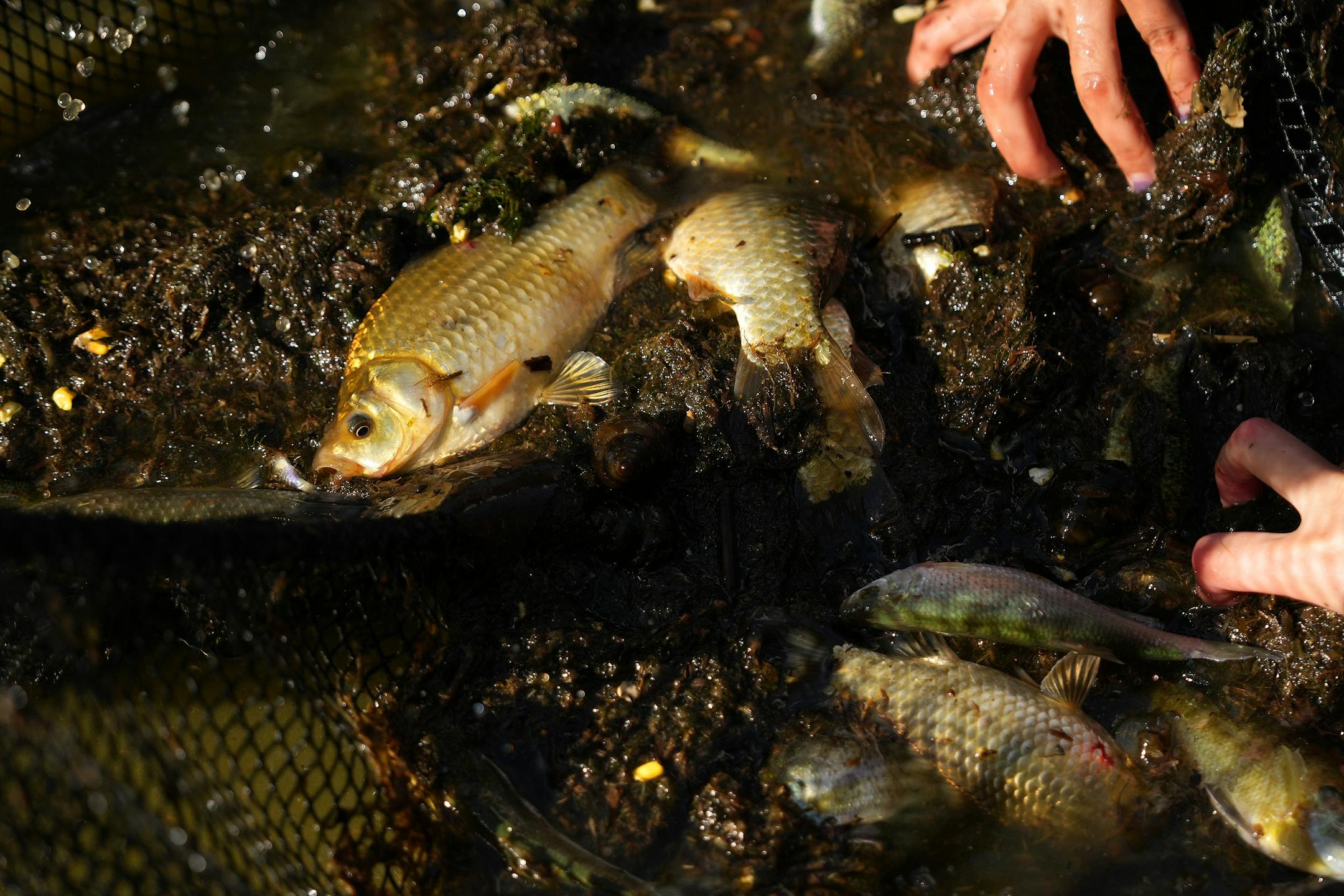
Officials have pulled “literal tons” of the goldfish out of lakes and storm drains across the Twin Cities, but the population grows as people dump them.
Goldfish, like these caught and removed from Edina’s Lake Cornelia in September 2025, continue to be a problem in Twin Cities lakes and storm drains. (Anthony Soufflé/The Minnesota Star Tribune)
Dozens of organizations help rehome dogs and cats when people can no longer care for them.
But rehoming another kind of pet — goldfish — is being floated as a way to clear waters flush with them.
The idea comes amid a rise in the population of the often oversized, orange-hued fish in ponds, lakes and storm drains across the Twin Cities. The problem has been growing for yearsthanks in part to people dumping their family fish tanks in the waterways.
Removing the fish, an invasive species, costs cities hundreds of thousands of dollars. Local officials have pleaded with people not to dump them, and in some cases, used the fish to feed bears at the Minnesota Zoo.
Community leaders and experts believe pairing the rehoming efforts with strategies for removal, including netting and fishing, might be the solution to getting rid of the former pets for good.
“[Large goldfish populations] are kind of becoming a new thing we’re noticing around Minnesota,” said Andrew Dickhart, the aquatic invasive species program coordinator for Carver County. “It takes just a few pet releases to really do a lot of damage on a local water or lake system that is enjoyed by a lot of people.”
Some city officials are urging residents to find new homes for fish instead of dumping them in the wild. (Anthony Soufflé/The Minnesota Star Tribune)
Rehoming efforts grow
Goldfish, carp cousins that unsettle lake bottoms, have been a problem in Minnesota for several years.
“They uproot native aquatic plants, and when the water is cloudy, sunlight can’t reach the bottom, and it leads to vegetation die-offs that native fish need,” said Hilarie Sorensen, a water resources extension educator at the University of Minnesota Duluth. “They are able to out compete native species for food and space.”
Dickhart has been fighting the fish since 2019, when Carver County saw a drastic increase in their numbers, mostly in the Grace Chain of Lakes in Chaska.
“All of the sudden, kaboom,” he said, “we had this huge population of aggregating goldfish.”
The county has spent thousands of dollars to catch the fish, even getting a permit from the state for electro-fishing, which stuns the animals so they can be removed.
Dickhart said his team has already seen marked water quality improvements since they removed “literal tons” of fish.
But people are still dumping them. So now, more communities are advocating for people to rehome their pets.
Sandy Moore, CEO of the national Pet Advocacy Network, said that can be as simple as bringing a goldfish back to the point of purchase. Habitattitude, a campaign by the Pet Advocacy Network to properly dispose of unwanted pets, hosts fish surrender events in Minnesota, she said.
There are also Facebook pages for fish swaps, she said, or people can contact the Minnesota Aquarium Society to find a new family for aquatic animals.
“The effects of releasing your pet into the wild is that fish is going to be somebody’s dinner,” she said. “Or, worst-case scenario, that animal becomes established, could reproduce and could displace native animals.”
Dickhart said rehoming is an essential part of minimizing the number of goldfish in Minnesota storm drains, ponds and lakes. Carver County has partnered many times with organizations to transfer pets, he said, rather than release them in the wild.
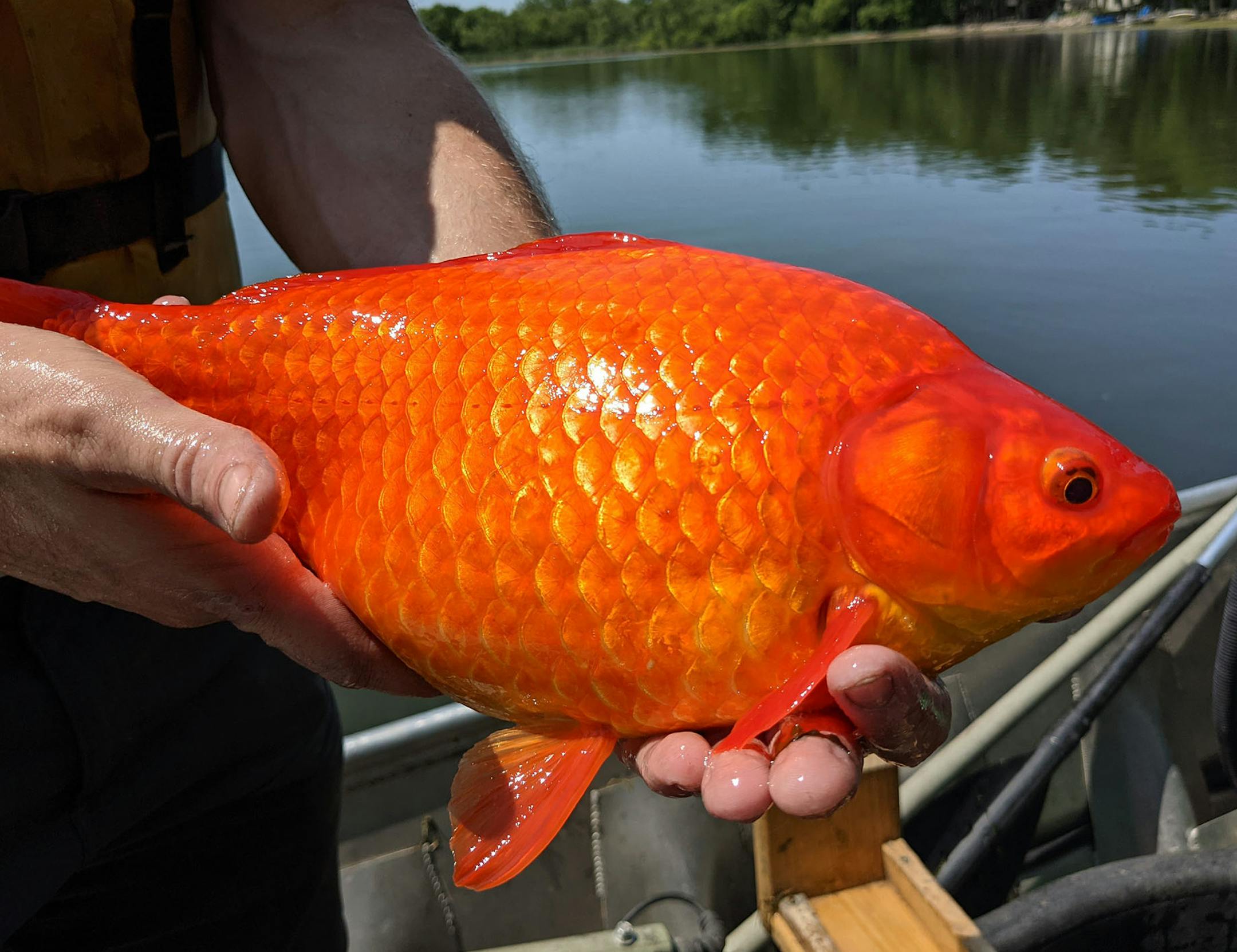
A football-sized goldfish was fished out of Burnsville’s Keller Lake in 2021. (City of Burnsville/The Minnesota Star Tribune)
The difficulties of catching goldfish
While they are relatively easy pets to care for, goldfish are actually a quite complicated species.
“They’re hearty little creatures and they undergo quite a transformation,” Sorenson said. “In the wild, they have no natural predators. They can grow to the size of a football or a dinner plate. They can weigh several pounds.”
Goldfish also don’t follow a pattern in terms of swimming or mating, but the Carver County staff in pursuit of them say the fish seem to catch on.
“Goldfish seem to just do what they want when they want,” Dickhart said. “They’re not dumb fish; they do have pattern recognition.”
When the Woodbury City Council discussed the fishy issue — a “mass of gold” in a pond near Powers Lake — at a May meeting, Mayor Anne Burt suggested people skip buying goldfish on impulse if they can’t care for them long term.
Instead, she said: “Purchase goldfish crackers, if you’re a goldfish lover.”
ABOUT THE WRITER
Eleanor Hildebrandt
REPORTER
Eleanor Hildebrandt joined the Minnesota Star Tribune as a fellow in June 2025. She was part of the team that won the Pulitzer Prize for Breaking News in 2026. Hildebrandt can be reached on