How You Can Help Stop Algae in Lake Minnewashta!

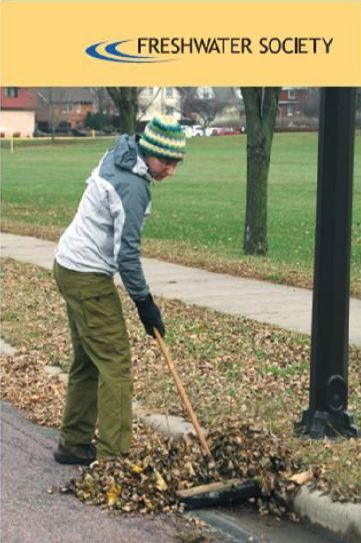
Imagine Minnesota’s 10.000 lakes full of clean, clear, fresh water for our children and grandchildren to enjoy. Fish are plentiful, birds line the shores, and there is water for recreation, industry and growing food. The Freshwater Society wants to help you make that vision a reality. The idea behind Community Cleanups for Water Quality is deceptively simple and cost-effective: locally-led groups of volunteers, rake, sweep, bag and remove loose dirt and leaves blocking sewer grates on city streets. The material is then composted to prevent pollutants such as phosphorusfrom entering lakes, rivers and streams.

Depending on the mix of materials, for every five bags (100 pounds) of leaves and other organic debris you collect, you prevent up to a pound of phosphorus from entering a local water body. Each pound of phosphorus can cause up to 1,000 pounds of algae. Your group or organization will be able to prevent thousands of pounds of algae growth in the lakes, rivers and streams near your home.

The Freshwater Society has assembled a toolkit to help you implement a Community Clean-Up for Water Quality in your area. For more information on Community Cleanups for Water Quality, or to download the Toolkit, visit our website:
http://freshwater.org

Share
Posted in Education, Lawn Care, News | Leave a comment

Zebra Mussel Update – July 14th, 2011

Greetings!

Here’s an update on what is happening with the Zebra Mussel threat on our lake and what your Lake Minnewashta Preservation Association board is doing about it. While we continue to work hard on this, we need your help. Please read on for specifics if you want to protect your lake.  


HOW CAN YOU HELP?

  • Watch the video prepared by the DNR and follow the laws and practices on your own watercraft. Share it with your neighbors and publicize it at your private access launches. Here’s a link     http://www.youtube.com/watch?v=laoJ_NP-XFo 
  • Be trained in zebra mussel watercraft inspection by coming to the Lotus Lake launch on Saturday 7/16 at 1PM.
  • Either volunteer your time or apply for a paid position to inspect watercraft.
  • Donate money to the LMPA to help pay for every incoming boat to be inspected for zebra mussels.
  • Lobby the Carver County Parks Commission and eventually the Carver County Board to require 100% watercraft inspection immediately and to find a funding source that does not include the LMPA.  
  • Sign petitions as they are circulated to demand this.
  • Contact Steve Gunther if you have any questions, comments or concerns.

ZEBRA MUSSEL REFRESHER

  •  Zebra mussels are a non-native species that breed exponentially and can limit recreational activities and alter aquatic ecosystems by displacing native species.
  • Minnesota has enacted new laws in 2011 for Aquatic Invasive Species Prevention (bill 11-0190) with enhanced authority for inspections and increased penalties for violations.                                
  • They have been found in nearby Lake Minnetonka and Prior Lake and spread predominantly by unintentional transfer on watercraft/trailers, in water in the boat or bait containers.  
  •  Currently there are no environmentally safe methods to kill zebra mussels once they become established in a natural system.                                
  • Because of this, the DNR does not try to eliminate zebra mussels if they become established in a lake or river.
  • This is why it is important to prevent their spread, since once they arrive in a water body there is no way to eliminate them.               


THE FACTS ABOUT ZEBRA MUSSELS AND THEIR IMPACT:

  • Fact 1: Zebra Mussels will attach to almost any hard surface
  • Fact 2: A single female will lay over 500,000 eggs in a spawning season.
  • Fact 3: Zebra Mussels will attach to outdrives, boat bottoms, boat lifts and docks which will typically cost $600 – $900 per year in motor, dock, lift repair, cleaning and prevention
  • Fact 4: Zebra Mussels have a life span of 4-6 years.  After dying their razor sharp shells will wash up on shore. 
  • Fact 5: Zebra Mussels are filter feeders, which may increase water clarity… BUT 
    • Milfoil thrives in clear water and weed banks will expand
    • Fish population can suffer in an environment with fewer nutrients. 


WHAT’S NEW WITH ZEBRA MUSSELS

  • The Zebra Mussel infestation that was observed in Lake Minnetonka bays has spread to many more bays. Here is a link to a recent article. http://www.startribune.com/local/west/125080804.html 
  • At this time, we have no known infestations on Lake Minnewashta but the risk remains very high. There are monitoring blocks in the lake that are to be used to assess the incidence of the mussels.
  • It is our belief that the education and random inspection system that was used in the past to prevent the spread of milfoil or curly leaf pondweed (which have fully infested our lake) did not work and will not work for zebra mussels and future invasive species.
  • Minnesota State law has been signed in June which significantly raises the penalties and fines for transporting invasive species. However, an audit of roughly 200 trailered boats launching at Lotus Lake indicates a 25% non compliance level with those laws. This included water in the boat or bait bucket and the drain plug in while transporting the boat.                  
  • The Lake Minnewashta Preservation Association board believes that 100% watercraft inspections are justified given the level of non compliance observed and the permanent impact an improperly cleaned watercraft can have on the quality of our lake and its ecosystem by transferring zebra mussels and their larvae into Lake Minnewashta.                                                 

WHAT’S UP WITH WATERCRAFT INSPECTION AT OUR PUBLIC LAUNCHES AT THE REGIONAL PARK

  • Watercraft inspection by DNR interns began May 14th but the inspectors worked only 25-30% % of available launch hours. Lack of funding and qualified inspectors was the gate. All DNR inspections at Lake Minnewashta have stopped due to the state shutdown on July 1st
  • Our attempts to implement 100% watercraft inspections at the Lake Minnewashta Regional Park with the financial help of the Lotus and Christmas Lakes homeowners Associations has not been successful to date. This is due to a number of entities questioning the legal authority to require a watercraft inspection at a location other than the lake into which a boater wishes to launch. We are appealing to the governor, the state attorney general and the commissioner of the DNR for help  

NOW WHAT?

  • Given that we cannot count on shared resources, your LMPA Board has voted to divert some of our current funds to pay for 100% inspections on our own at the Regional Park. We agreed to use approximately $5000 of money donated by residents to the LMPA and $5000 of money granted to us by the Minnehaha Creek Watershed District.
  • The Carver Parks authority supports this inspection, as long as it remains voluntary.
  • The LMPA is now implementing a plan where DNR-trained volunteers/inspectors will man the boat launch to the best of our ability. A single inspection station will be implemented at the east launch to optimize our available resources. All incoming watercraft will be directed to that launch for inspection.               
  • We successfully negotiated an agreement with Lotus Lake homeowners association to use their Zebra Mussel Inspection manager to oversee our resources as well as many of their trained inspectors (who are willing) to operate our station.  span>    
  • We need more inspectors (volunteer or paid) willing to work and are advertising for inspectors (preferably DNR trained) to work the launch from 6AM to 9PM Monday to Sunday. See the Craigslist posting at: http://minneapolis.craigslist.org/csw/edu/2486816445.html. Contact Scot Lacek at scotlacek@hotmail.com.
  • Our next training session is Saturday July 16th at 1PM at Lotus Lake public boat access at 7610 South Shore Drive in Chanhassen. The training will take 20-30 minutes.                                                           

WHAT ABOUT 2012?

  • The LMPA board is taking the position that our homeowners association cannot (nor should they) afford to pay for the cost of preventing Zebra Mussels and other invasive species from entering Lake Minnewashta.                                                       
  • On July 13th, we presented to the Carver Parks Commission and requested an increase in park fees be implemented in 2012 and beyond to cover the cost of inspections by the DNR or its trained agents to prevent the spread of aquatic invasive species into Lake Minnewashta. We believe that to not do so is to ignore Carver Parks’ responsibility to maintain the natural resources put in your care.
  • This will be presented to the Carver County Board on July 26th.

HOW CAN YOU HELP?

  • Watch the video prepared by the DNR and follow the laws and practices on your own watercraft. Share it with your neighbors and publicize it at your private access launches. Here’s a link     http://www.youtube.com/watch?v=laoJ_NP-XFo
  • Be trained in zebra mussel watercraft inspection by coming to the Lotus Lake launch on Saturday 7/16 at 1PM.
  • Either volunteer your time or apply for a paid position to inspect watercraft.
  • Donate money to the LMPA to help pay for every incoming boat to be inspected for zebra mussels.
  • Lobby the Carver County Parks Commission and eventually the Carver County Board to require 100% watercraft inspection immediately and to find a funding source that does not include the LMPA.  
  • Sign petitions as they are circulated to demand this.
  • Contact Steve Gunther if you have any questions, comments or concerns.

Please send your tax deductible check to: LMPA, PO Box 304, Excelsior, MN 55331.

Or donate through PayPal by following the link on our website, www.lakeminnewashta.org :

Steve Gunther
Lake Minnewashta Preservation Association

Share
Posted in Education, News, Zebra Mussels | Leave a comment

Local News Wrap – Lake Minnetonka Zebra Mussels

Here’s a news wrap up of local stories that were run recently regarding the fast spread of zebra mussels in Lake Minnetonka and their impact on the lake. Click on each story title to open the story in a new window.

MCWD has a program called Save Our Summers that provides information on what lakeshore owners and boaters should do to help prevent the spread of zebra mussels. If you or anyone you know are bringing a boat into Lake Minnewashta be sure to be aware of these steps to help prevent introducing this invasive species into the lake.

Share
Posted in Education, News, Zebra Mussels | Leave a comment

2011 Independence Day – Schedule of Events

Monday, July 4th

8:45 a.m.
Gather on the Quarberg, Wintheiser, Livingston lawns before the Ski Show.
3311 Shore Drive, Excelsior, MN

9:00 a.m.
Lake Minnewashta Ski Show
Quarberg, Wintheiser, Livingston Lawns
Please bring a chair or a towel to sit on!

11:30 a.m.
Lake Parade – Starts on Maplewood Circle

8:00 p.m.
Boat Parade
Meet at the Minnewashta Regional Dock

Dusk (approx 10:00 p.m.)
Fireworks

Share
Posted in Events, Fireworks, News, Other Events, Water Ski Show | Leave a comment

One Boat Away

Insanity is doing the same thing, over and over again, but expecting different results. Some
smart guy named Albert Einstein said that and it’s a thought that comes to mind when considering our
collective response to Aquatic Invasive Species in our Minnesota waterways.

In the past, the recreational quality of our metro area lakes has been highly impacted by the
unintentional transfer of invasive species from one lake to another. Curly Leaf Pondweed and Eurasian
Milfoil are just two examples. Within two to three years of appearing in one lake, they are observed
in adjacent lakes. These mats of weeds have clogged many a propeller and made many fine lakes un-
navigable as they reproduced and multiplied. Public and private monies were spent to reduce their
impact, either by treating them with chemicals (are these multi syllable compounds really safe?) or
harvesting them with nautical threshers (where does all the stinky wet “hay” with entangled fish end up
anyway?). A lakeshore home owner might typically spend $200-$600 per year in an attempt to reduce
them for a season in their immediate shoreline. Citizen-based Lake Associations might spend $5000 to
$15,000 to fight them in the common areas, trying to open up lanes so boats can move from one part of
a lake to another. Parks Departments do the same. Grants from the DNR and other public entities help
defray the costs but real money is spent. Our collective money is spent. Your money is spent.

Now the latest invasive species threat in our lakes, zebra mussels, is at our doorstep. When
you see a picture of one of these brown and gold striped mini morsels nestled in a finely manicured
hand, you react the same way as you might when you see a baby rabbit. Cute! The problem is that they
reproduce like rabbits and, once established, there is no environmentally safe control method to kill
them. Because of this, the DNR does not try to eliminate zebra mussels if they become established in a
waterway. The mission becomes only one of containment.

“So what?” some people ask, “What’s the big deal?” Unlike invasive weeds, which are a nuisance
when they infect a lake, zebra mussels are a disaster. Medicine Lake resident Scott Burglechner
has firsthand experience with zebra mussels. He can tell you what the big deal is. Following are his
observations.

  • “Zebra mussels reproduce like rabbits and are tough, clingy, and sharp, like razors.”
  • “My recollection is that zebra mussels were first detected in Cayuga Lake (in western New
    York State) in 1993 or 1994. The lake was fully infested with them by 1995. This is a lake that
    stretches 38 miles.”
  • “Here is what infestation looks like: clumps of tiny razor sharp shells attached to any hard
    surface—rocks, docks, pipes, boats—and my perception is that the shallower the water, the
    greater the infestation.”
  • “Within a year every boat in the lake had to be on a lift. They really clog intake lines on boats
    and irrigation systems.”
  • “We had to start wearing shoes in the lake to prevent our feet from being cut.”
  • “I have seen people dive from docks, brush the bottom of the lake, and come up with deep cuts
    from the zebra mussels.”
  • “I have observed that the water appears clearer than it used to, allowing weeds to grow thicker
    and removing food from the ecosystem for young fish.”
  • “I am scared about what these animals could do to our Lake. It is much smaller and shallower
    than Cayuga Lake. I believe serious impacts to the natural and recreational uses of our lake are
    ONE BOAT AWAY.”

These beasts are currently infesting many lakes in the Metro Area including Lake Minnetonka, Lake
Nokomis and Prior Lake. Their spread from lake to lake most likely occurs when improperly cleaned
boats enter clean waters after having been in infected waters. The tiny mussels or their larvae are
stowaways on the watercraft or trailer, in the water in the motor, bilge, bait bucket or livewell or in
aquatic vegetation and transferred when the boat is launched into clean waters. While there are laws
in place with moderate fines to protect against this kind of transfer, the level of boater knowledge and
compliance to these laws is truly anyone’s guess. A conservation officer from the Morris area reported
that 25% of the boats he inspected were being transported illegally with their drain plugs in and the
boats undrained. (Star Tribune, 6/5/11). With that kind of performance, your favorite lake may be ONE
BOAT AWAY from being added to the list of infected waters. And unlike invasive weeds, which are a
nuisance when they infect a lake, zebra mussels are a disaster.

This is when Albert Einstein’s famous quote comes to mind. With a lot of money, we’ve used public
service messages and random boat inspections in the past and have only slowed the transfer of previous
invasive species. That approach is not good enough. We need a much higher level of attention and the
resources to inspect every boat coming and going from the launches. We need each and every boater
reminded of the rules and fined if they don’t comply. We need tools to clean and disinfect the boat and
trailer at the launch station. But can we afford it?

Governor Dayton just signed the Aquatic Invasive Species legislation to ramp up the battle but, while
much improved, it doesn’t provide sufficient resources. With over 3000 Lakes with public accesses in
the state, the costs would be huge to provide just inspection resources at every one of them. There are
roughly 2000 hours of launch access during the period that the water is warm enough for zebra mussel
larvae to survive. Providing an inspector at each launch (assume $10/hour) would cost $20,000. Total
cost, $60 million. Is this likely to be added to our state budget? Nope. Will boat fees be immediately
raised statewide to pay for this kind of thing? Don’t hold your breath. Are Lake Associations willing to
foot part of the bill for their individual lake access? Absolutely but most can’t raise the kind of money
needed.

So what’s the solution? We must be creative and must combine our resources to protect our lakes. The
leaders of the lake associations from Christmas Lake, Lotus Lake and Lake Minnewashta have formed
the Lake Action Alliance (LAA). Our lake associations are willing to pool our money and volunteers. We
are actively working with the Carver Parks authorities, The Minnehaha Creek and Riley Purgatory Bluff
Creek Watershed Districts and the leadership of Chanhassen and Shorewood to pilot a program where:

  • The individual education of boaters and inspection of their boat and trailer is not performed at
    each individual launch on each lake but performed at a central inspection site on one lake.
  • Once certified as “clean” at the inspection site, the boater is free to launch at any of our three
    lakes.
  • A keypad controlled access gate at the remote launch site would prevent uncertified boats from
    launching but the certified boater would be given a single use key code to enable their launch.
  • Is it inconvenient to boaters wishing to launch? Yes, but nowhere near as inconvenient as when their
    favorite lake is contaminated and permanently infested with zebra mussels. If the next boater after you
    is careless or uninformed, you may be ONE BOAT AWAY from having their favorite lake being added to
    the list of infected waters.

    So what do we need? We all have to sacrifice a little to make this happen. We need our city, county
    and state leaders to help us do the right thing, not just what is popular or politically safe. They must
    require that this pilot be launched immediately and that its guidelines be followed. We need our Lake
    Association members to help with the funding for the pilot or volunteer if they can’t. We need our
    Watershed Districts to help with the communication and funding, if they can. We need the DNR to help
    us staff, train and manage the resources. We need the Sheriff’s department to ticket the violators. We
    need the boaters to be understanding, cooperative and part of the solution. And we need all citizens to
    contact their local authorities with their support for the concept.

    Let’s get this method in place for this summer and we can find a more elegant solution for the future.
    But we just can’t keep doing what we’ve done in the past and expect different results. That’s insanity.

    Steve Gunther,
    Chanhassen
    President, Lake Minnewashta Preservation Association

    Share
Posted in News | Leave a comment

What’s your vision for Lake Minnewashta?

As you may know, the Minnehaha Creek Watershed District, with help from Minnesota Waters, selected the Lake Minnewashta Preservation Association for training that will guide our association through the process of creating a comprehensive Lake Management Plan (LMP). The LMP addresses all aspects of our lake and provides the opportunity to create a comprehensive guide to addressing the top priorities for our group. Additionally, we are eligible for $2400 in funding that we will apply to improving the quality of the lake.

As part of the Lake Management Plan program, the LMPA is hosting a community visioning session to seek your input! Please join us on May 14th at Faith Lutheran Church (corner of Minnewashta Parkway and Highway 5) from 9:30 a.m – 12:00 noon

We will be discussing and asking for your input on the lake management plan and the action plans we should be taking on topics, such as:

· Invasive species
· Fisheries
· Runoff and erosion

As part of the lake management plan program, a few LMPA members attended a day-long training session which provided funding information, while broadening our horizons and increasing our knowledge of our lake and what we can do to “enhance” its quality. We look forward to sharing information about this program with you and hearing your input!

We hope to see you on May 14th !

Please contact Paul Quarberg at pquarberg@gmail.com to confirm your attendance or for more information.

Share
Posted in Meetings, News, Upcoming Meeting(s) | 1 Comment